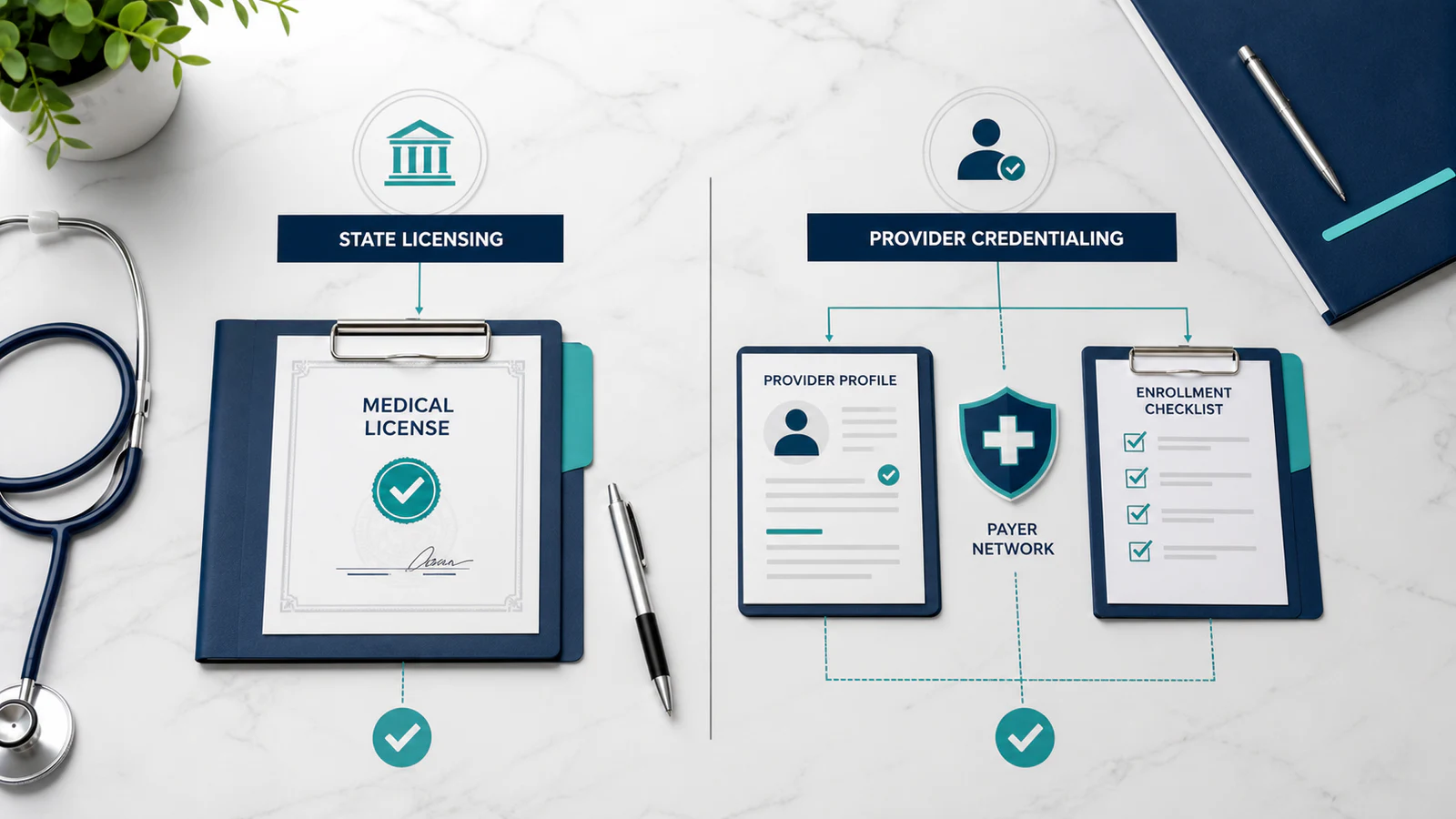
State licensing and provider credentialing are related, but they solve different problems. Licensing gives a clinician authority to practice in a state. Credentialing and payer enrollment establish that a licensed provider meets participation requirements and can be linked to a payer network, group, location, and billing arrangement.
State licensing comes first when a license is required
A provider planning to practice in a new state should first confirm the applicable board requirements. Education, training, examinations, background checks, verifications, and state-specific documents may be involved. Approval timelines depend on the board and the completeness of the application.
- Requirements and eligibility review
- Primary-source documents and verifications
- Application preparation and submission
- Board follow-up through license status
Credentialing and payer enrollment follow an active license
Once the provider has the required license, the credentialing process organizes and validates the professional profile used by hospitals, groups, and payers. Payer enrollment then connects the provider to specific contracts and billing relationships.
- CAQH profile setup, attestation, and maintenance
- Payer and product selection
- Individual and group enrollment applications
- Follow-up, effective-date confirmation, and participation tracking
Plan backward from the intended start date
Licensing and payer enrollment should be part of recruitment and expansion planning, not tasks started after a provider arrives. Create a dependency map for the license, DEA or controlled-substance requirements when applicable, malpractice coverage, CAQH, group records, locations, contracts, and payer applications.
Keep the provider file current after approval
Credentialing does not end when the first approval arrives. Maintain attestations, expiring documents, recredentialing dates, location changes, ownership records, and payer effective dates so the provider remains ready to deliver and bill for care.
Practical takeaway
If the provider does not yet have the required state license, begin with licensing. If the provider is licensed and needs network participation, begin credentialing and payer enrollment.
Compare Licensing and CredentialingThis article provides general educational information and is not legal, coding, clinical, or payer-contract advice. Requirements vary by payer, state, specialty, and organization.